A2X alternativeA2X keeps your books.
Remworth shows what each product made.
Looking for an A2X alternative? Start with what A2X is: a bookkeeping connector that turns each Amazon settlement into a summary entry in QuickBooks Online, Xero or NetSuite. Remworth checks every settlement inside its own app and works out profit per product with FIFO cost. It does not post to QuickBooks or Xero. Here is what each one does well, and which one you need.
- A2Xpayout summaries in your accounting software
- Remworthevery settlement checked, profit per product
- QuickBooks or XeroA2X yes, Remworth no
- CheckedA2X's own site, October 2026
The short answer
A2X and Remworth both read Amazon's settlements. They use them for different jobs.
A2X is a bookkeeping connector. It turns each Amazon payout into a categorized summary in your accounting software, so your books match your bank. Remworth is seller software for US Amazon resellers. It keeps its own books sale by sale, checks them against every settlement statement, and shows profit per product, alongside sourcing, purchasing, receiving and FBA shipping.
- Your books live in QuickBooks Online, Xero or NetSuite? Keep A2X, or a connector like it. Remworth does not post there.
- You want to know what each product and each sale made? That is Remworth's job, with FIFO cost and every deposit checked.
- You also sell on Shopify, Walmart or eBay, or outside the US? A2X covers those. Remworth is amazon.com only.
- You want clean books and per-product profit? Run both: one keeps the ledger, the other tracks profit.
What A2X does well
Here is A2X as its own website describes it, checked October 2026. These are real strengths, and Remworth does not try to do most of them.
- Settlement summaries in your ledger. For each Amazon settlement period, A2X posts an auto-categorized summary of sales, FBA fees, taxes, refunds and more to QuickBooks Online, Xero or NetSuite. Its home page also lists Sage.
- Entries that match the bank. Each summary matches the money Amazon deposited in your bank account.
- Tax mapping. It assigns rules by transaction type, taxable or non-taxable sale, and country. Where Amazon has collected marketplace facilitator tax, A2X shows what was collected and what was submitted.
- Cost of goods sold in the books. On Starter plans and up, you upload your SKU costs and A2X creates a summarized COGS entry. Those plans also include FBA inventory locations.
- Payouts that span two months. It helps you record income properly when a pay period covers parts of two months.
- QuickBooks Desktop, by file. For QuickBooks Desktop and Enterprise, A2X exports an IIF file for each settlement that you import yourself.
- More than Amazon. Shopify, eBay, Etsy, Walmart, TikTok Shop and PayPal, and a directory where you can find an ecommerce accountant or bookkeeper.
- Help getting set up. Mini, Starter and Standard come with email and live chat support and one-to-one onboarding. Standard 10k and the Premium plans get premium one-to-one support.
A2X also says its entries help you keep track of profit margins, COGS and channel performance through accurate financial statements in your accounting software. Its QuickBooks page notes that many larger customers use inventory management software alongside A2X. None of the A2X pages we read covers sourcing, purchase orders, receiving or FBA shipments.
What Remworth does with the same settlements
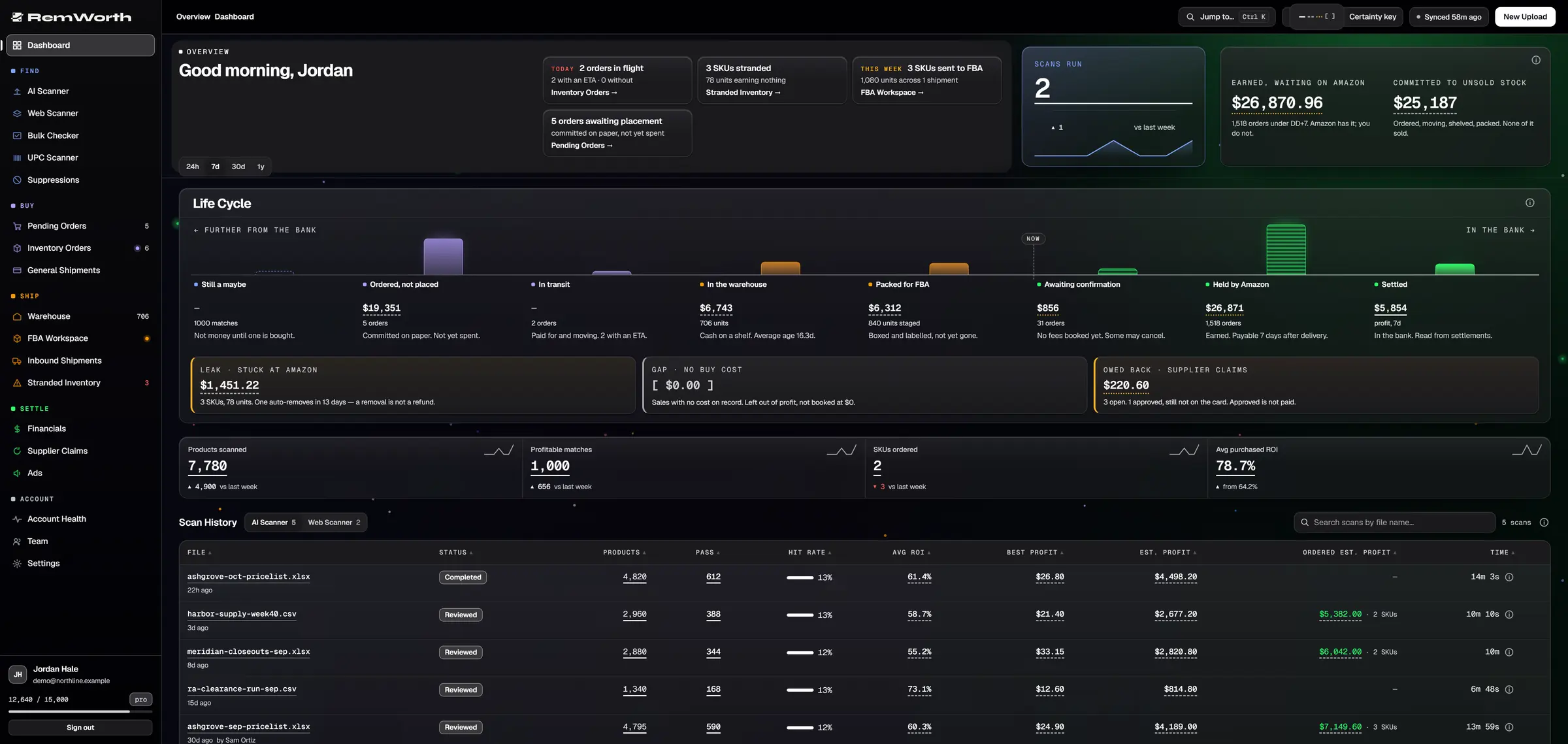
You connect your Amazon account once, through Amazon's own consent screen. Remworth then keeps its own books, sale by sale, and checks them against every settlement statement Amazon issues.
- Every statement checked. Sales, fees, promotions, refunds, reimbursements and ad spend, each compared with the books and shown with the difference per statement, plus your lifetime deposit total.
- Nothing dropped quietly. Statement lines Remworth doesn't recognize are flagged, never dropped. Orders on a deposit but missing from the books are listed by order ID.
- Profit per product and per period. Built from Amazon's own financial events, corrected against its settlement statements, plus your recorded costs. FIFO cost, inbound freight, refunds, reimbursements, storage and service fees, ad spend, promotions and removals are all netted in.
- Estimates marked until fees post. A fee Amazon hasn't finalized yet uses Amazon's own estimate, and the real fee replaces it once it posts.
- FIFO cost on every sale. Each received batch becomes its own cost layer at the price you actually paid. A sale with no recorded cost is held out of profit and listed, never booked at $0.
- Refunds itemized. Each refund shows the amount, the fees Amazon returned, the fee Amazon kept, and the net impact.
- Payouts on one card. Every expected payout with its date and statement period, and your 24 latest bank transfers with the bank trace ID. Money Amazon is still holding shows on the P&L under its own label: earned, not yet paid out.
- Sales tax by state. Any year, quarter or month, every state on one line, with marketplace facilitator tax kept apart from item tax. Exports as CSV.
- Your history. The last 90 days or so of statements arrive by themselves. Older statements (the Flat File V2 files you download from Seller Central) come in through a guided import. Sales come in from an InventoryLab export, or through Remworth's template for sales more than about two years old.
What your accountant gets is files: the P&L as a one-page summary, by ASIN, by supplier or by month, in CSV or Excel, for any date range. The export foots line by line, with contra-COGS credit lines included. Your bookkeeper can also have their own login with the Bookkeeper role.
A2X vs Remworth, side by side
| The job | A2X | Remworth |
|---|---|---|
| Post to QuickBooks Online, Xero or NetSuite | Yes, a summary per settlement | No |
| QuickBooks Desktop | Yes, by IIF file import | No |
| Match each Amazon payout | In your accounting software, against the bank deposit | In the app, statement by statement, with the difference per category |
| Cost of goods sold | A summarized COGS entry from SKU costs you upload (Starter and up) | FIFO cost on every sale, from the price paid for each received batch |
| Profit view | Margins and COGS through the financial statements in your accounting software | Per ASIN and per period, with refunds, storage and ad spend netted in |
| Sales tax | Rules by transaction type and country, posted to your ledger | A state-by-state table by year, quarter or month, with a CSV export |
| Sales channels | Amazon, Shopify, eBay, Etsy, Walmart and more | Amazon only |
| Amazon marketplaces | Every marketplace under a Merchant ID | amazon.com (US) only |
| Sourcing, buying, receiving, FBA shipments | Not on the pages we read | Yes |
| What sets the price | Orders per month; each plan covers a set number of Merchant IDs | Your plan, plus any extra team seats or scan rows you buy; orders, ASINs and revenue never change it |
| Price | $29 to $1,499 a month by orders per month; custom pricing above 250,000 | Solo $199.99 or Pro $349.99 a month, month to month. Selling more never raises the bill |
| Free trial | All features; can post three settlements to your accounting software | 7 days, card required; cancel before day 8 and pay nothing. AI scan rows start with a paid plan; this month's P&L, the UPC Scanner (5,000 rows a file), the 500-ASIN Bulk Checker, labels and FBA shipping all run in it |
| What you hand your accountant | Entries already in the ledger | CSV and Excel files |
What A2X costs, and how Remworth bills
A2X for Amazon is priced by orders per month. Plans up to Standard 10k cover one Amazon Merchant ID; Premium plans cover 5 to 20. One A2X account covers every marketplace under a Merchant ID. These are the US dollar prices on A2X's Amazon pricing page, checked October 2026.
| Plan | Per month | Orders per month | Notes |
|---|---|---|---|
| Mini | $29 | up to 200 | 3 months of history; no COGS or FBA inventory locations |
| Starter | $59 | up to 1,000 | 12 months of history; COGS and FBA inventory locations included |
| Standard | $79 | up to 5,000 | 24 months of history; COGS and FBA inventory locations included |
| Standard 10k | $159 | up to 10,000 | maximum history; premium one-to-one support |
| Premium | $229 to $1,499 | 15,000 to 250,000 | 5 to 20 Merchant IDs, premium one-to-one support; custom pricing above 250,000 |
Prices can change. Check A2X's pricing page before you buy.
Remworth is Solo $199.99 or Pro $349.99 a month, month to month. It is not priced by orders, so selling more never raises the bill: you pay for your plan, plus any extra team seats or scan rows you choose to buy. Details are on the pricing page.
The trial runs 7 days with a card on file, and nothing is charged if you cancel before day 8. AI scan rows start with a paid plan; this month's P&L, the exports, labels and FBA shipping run in it.
If you run both, you pay two subscriptions. That is the plain cost of clean ledger entries and per-product profit at the same time.
Which one do you need?
Choose A2X if
- Your books are kept in QuickBooks Online, Xero, NetSuite or Sage, or in QuickBooks Desktop by file.
- Your accountant or bookkeeper wants each payout posted as a ledger entry that matches the bank.
- You sell on Shopify, eBay, Etsy, Walmart or TikTok Shop as well as Amazon.
- You sell in Amazon marketplaces outside the US.
Choose Remworth if
- You sell on amazon.com and want to know what each product made after FIFO cost, fees, refunds, storage and ad spend, and what each sale made after its cost and fees.
- You want every settlement checked against your sales, with missing orders and unknown lines named.
- You want sourcing, purchase orders, package tracking, receiving, FBA shipments and profit in one app.
- Your accountant works from a P&L file rather than a ledger feed. Ask them first.
Run both if
You want clean books in your accounting software and per-product profit for buying decisions. A2X keeps the ledger; Remworth runs the reseller side. Agree with your accountant which tool's cost of goods goes into the tax books, so cost is not counted twice.
What Remworth doesn't do
- It doesn't connect to QuickBooks (Online or Desktop), Xero, NetSuite or Sage, and it posts no journal entries. Exports are CSV and Excel.
- It checks Amazon's statements against its own books, not against your accounting file.
- It doesn't sell on other channels. No Shopify, Walmart, eBay or Etsy, and only amazon.com: a non-US seller account is refused at connection.
- It doesn't file tax returns or issue 1099s, and it isn't an accountant. It gives your accountant the files.
Read next
Test it on the same job
Check this month's sales against Seller Central.
Run the check you would run on any tool: Remworth's numbers against Amazon's own, for a month you can see in Seller Central.
- Connect your amazon.com account. This month's orders start filling in right away.
- In Financials, pick Month to date and set the revenue beside Seller Central's sales for the same days. The revenue includes orders still pending at Amazon, and a separate line names the pending orders and their total.
- Open the P&L by ASIN and check a few products: revenue, fees, cost, profit and units sold.
Start the 7-day trial. All of this runs in it.
Questions
A2X questions sellers ask
What is A2X?
A2X is accounting software for ecommerce sellers. For Amazon, it turns each settlement into an auto-categorized summary of sales, fees and taxes and posts it to QuickBooks Online, Xero or NetSuite, so the entry matches the payout in your bank. It also connects Shopify, eBay, Etsy, Walmart, TikTok Shop and PayPal. (From a2xaccounting.com, checked October 2026.)
Is Remworth an A2X alternative?
Partly. Both read Amazon's settlements and both help you trust a deposit. A2X's job is your accounting ledger. Remworth's job is profit per product, with every settlement checked against its own sale-by-sale books. Remworth posts nothing to QuickBooks, Xero, NetSuite or Sage, so if your books live in one of those, it does not replace A2X.
Do I need A2X if I already use a profit tracker?
If your books are kept in QuickBooks Online, Xero or NetSuite, you need some way to get each Amazon payout into them, and A2X is built for that. Remworth tells you which products make money; it posts no ledger entries. If you don't use accounting software, ask your accountant whether a P&L file is enough. Remworth exports one by month, by ASIN or by supplier, as CSV or Excel.
How much does A2X cost?
A2X for Amazon is priced by orders per month. Checked October 2026: Mini $29 a month (up to 200 orders), Starter $59 (1,000), Standard $79 (5,000), Standard 10k $159 (10,000), and Premium plans from $229 (15,000) to $1,499 (250,000), with custom pricing above that. Plans up to Standard 10k cover one Amazon Merchant ID. The free trial includes all features and can post three settlements to your accounting software. Prices change, so check A2X's pricing page. Remworth is Solo $199.99 or Pro $349.99 a month and is not priced by orders.
Does A2X do cost of goods sold?
Yes, on Starter and higher plans, not Mini. You upload your SKU costs and A2X creates a summarized COGS entry in your accounting software. Remworth handles COGS differently: each received batch becomes its own cost layer at the price you paid, every sale carries its own FIFO cost, and a sale with no recorded cost is held out of profit instead of booked at $0.
Does A2X work with QuickBooks Desktop?
Yes, by file. A2X's help center says it exports a specially formatted IIF file for each settlement, which you import into QuickBooks Desktop or QuickBooks Enterprise. For QuickBooks Online, Xero and NetSuite, A2X posts the summaries for you.
Does Remworth integrate with QuickBooks or Xero?
No. Remworth has no QuickBooks, Xero, NetSuite or Sage connection and posts no journal entries. You get files instead: the P&L as a summary, by ASIN, by supplier or by month in CSV or Excel, and the state sales tax table as CSV. Your bookkeeper can also have their own login with the Bookkeeper role.
How do I reconcile an Amazon settlement with my bank deposit?
Start from the deposit, not your sales. For each statement, Amazon's settlement report gives the deposit date and the total, then each transaction behind it, with its type, the kind of charge or fee, and the amount. Match each category to your books. A2X does that inside your accounting software. Remworth does it in the app: each statement is compared with the books category by category, orders missing from the books are listed by order ID, and unrecognized lines are flagged, never dropped.
Check your next deposit, order by order.
Connect your Amazon account, let Remworth read your settlements, then compare. If your books live in QuickBooks or Xero, keep A2X for the ledger.
Solo $199.99/mo · Pro $349.99/mo · 7 days free, card required
On your phone? Start with just your email. The link we email you works once, on any device, within 7 days, and the app opens once you've picked a plan, added your card and connected your Amazon seller account.
Your Amazon password stays with Amazon. How Remworth connects.
Sources
- A2X for Amazon pricing plans in USD, orders per month, Merchant IDs, history, COGS and FBA inventory locations by plan, trial, support and onboarding (checked October 2026)
- A2X home page sales channels, NetSuite and Sage, accountant and bookkeeper directory, margin and COGS tracking (checked October 2026)
- A2X: Amazon to QuickBooks Online summaries per settlement period, matching the deposit, tax rules, COGS entry, inventory software alongside (checked October 2026)
- A2X: Amazon to Xero summaries that match the deposit, marketplace facilitator tax, pay periods with blended months (checked October 2026)
- A2X help: Amazon with QuickBooks Desktop and Enterprise an IIF file per settlement, imported into QuickBooks Desktop or Enterprise (checked October 2026)
- Amazon Selling Partner API: Settlement reports settlement reports are scheduled by Amazon and cannot be requested; Flat File V2 replaces the older flat file and XML reports; deposit date, total, and the type and amount of each line