Amazon wholesale software for FBA resellersFrom the price list
to profit by supplier.
Amazon wholesale means buying branded products in bulk from the manufacturer or a wholesale supplier and reselling them on listings already live on Amazon. Remworth runs that whole loop in one place: the supplier's price list, the purchase order, the receive, the shelf, the shipment to FBA, and each supplier's gross profit.
Solo $199.99/mo · Pro $349.99/mo · 7 days free, card required
- Price listswith UPCs or without
- Orderinggrouped by supplier, entered once
- FreightAmazon partnered parcel and pallet quotes
- Marketplaceamazon.com only
The wholesale workflow
From the supplier to Amazon's dock, on four screens.
Selling wholesale items on Amazon
How Amazon FBA wholesale works, step by step.
Whatever the category, the job is the same: buy right, make sure your account can sell it, get it into Amazon, and learn which suppliers pay. Here is each step, and the part Remworth plays in it.
- Find and vet a supplierBuy from the manufacturer or from a wholesale supplier. Amazon's own guide suggests trade shows, referrals, professional networks and its Service Provider Network, and asking each wholesaler about minimum order quantities, cost per unit and other costs like membership fees. Remworth doesn't find suppliers. It keeps a directory of the ones you buy from, so names stay consistent everywhere.
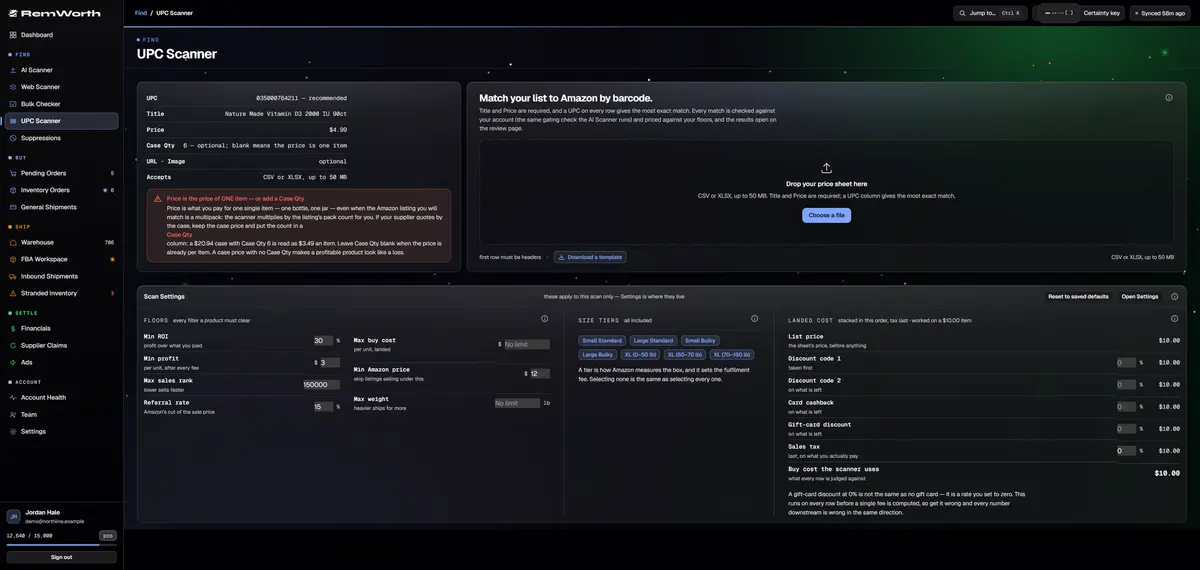
- Check the price listA distributor list with barcodes goes through the UPC Scanner: up to 5,000 rows matched to Amazon by UPC or EAN, with price, rank, fees from Amazon's rate card, pack count and hazmat flags. A list without barcodes goes through the AI Scanner, which finds each product on Amazon and verifies the match with AI. Quoted by the case? Add a Case Qty column and the case price is read as a per-item cost.
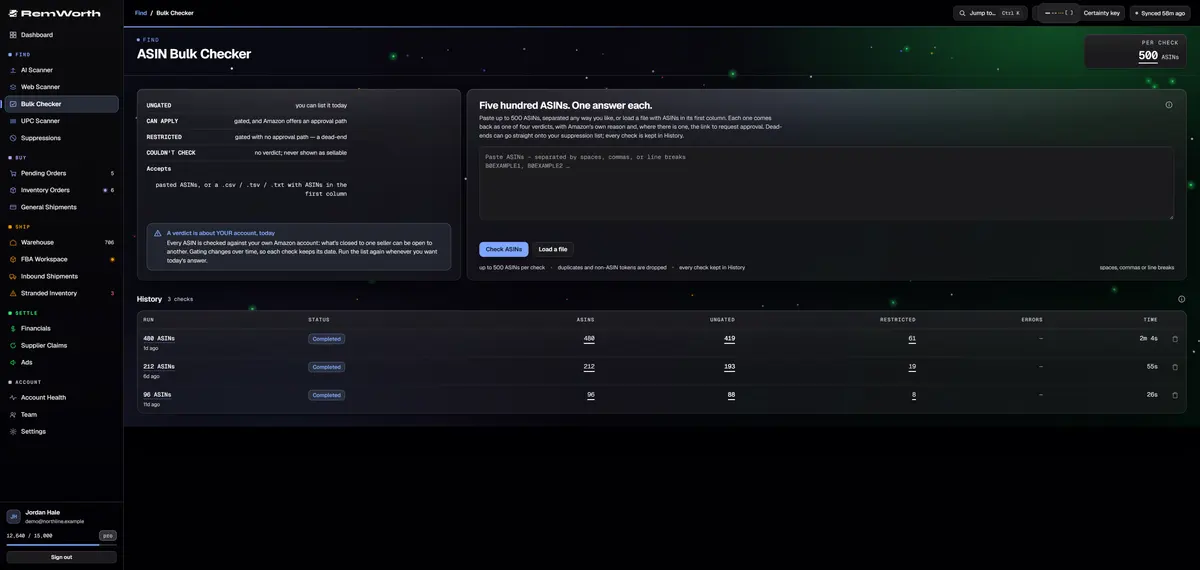
- Check what your account can sellPaste up to 500 ASINs into the Bulk Checker and each comes back Ungated, Can apply (with Amazon's approval link) or Restricted, from your own seller account. The UPC Scanner and the AI Scanner also check gating while they scan. When a brand needs approval, Amazon asks for a manufacturer or distributor invoice or a brand authorization letter. Remworth links the application; you file it.
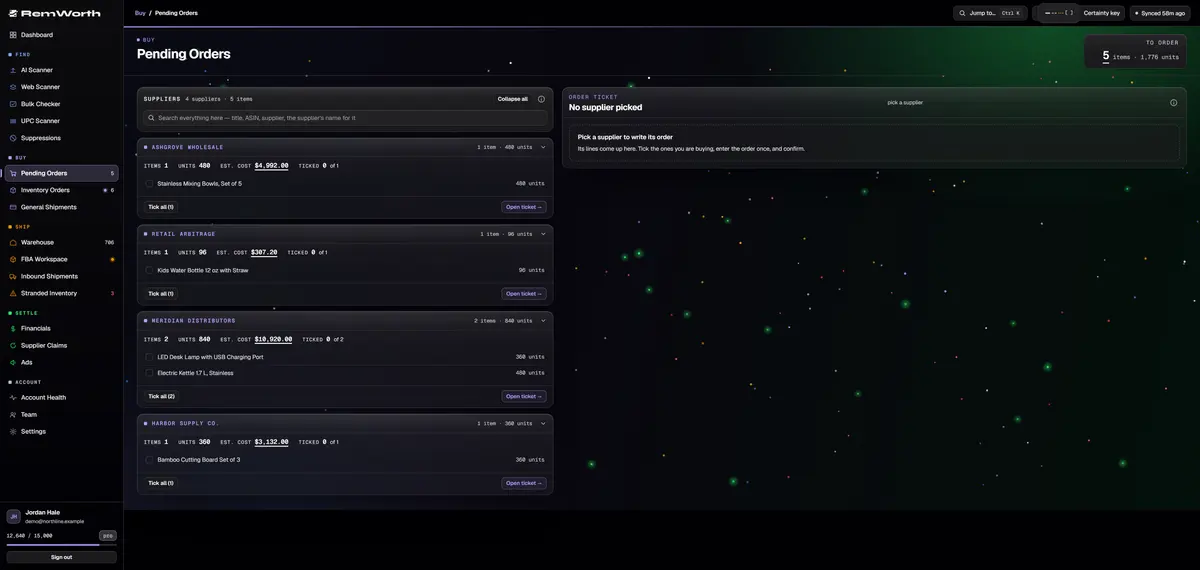
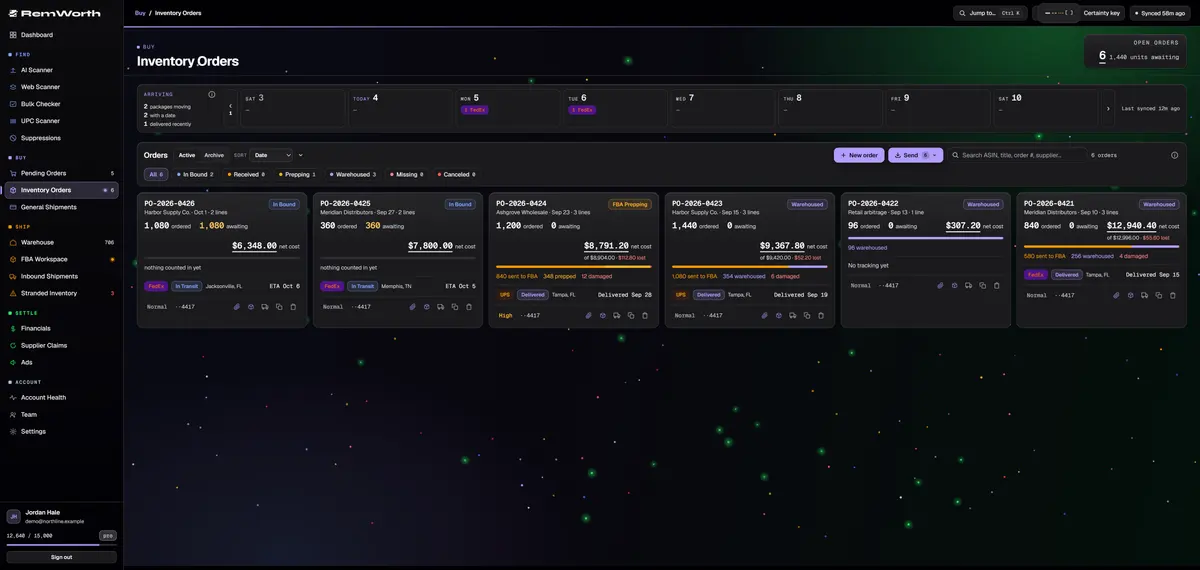
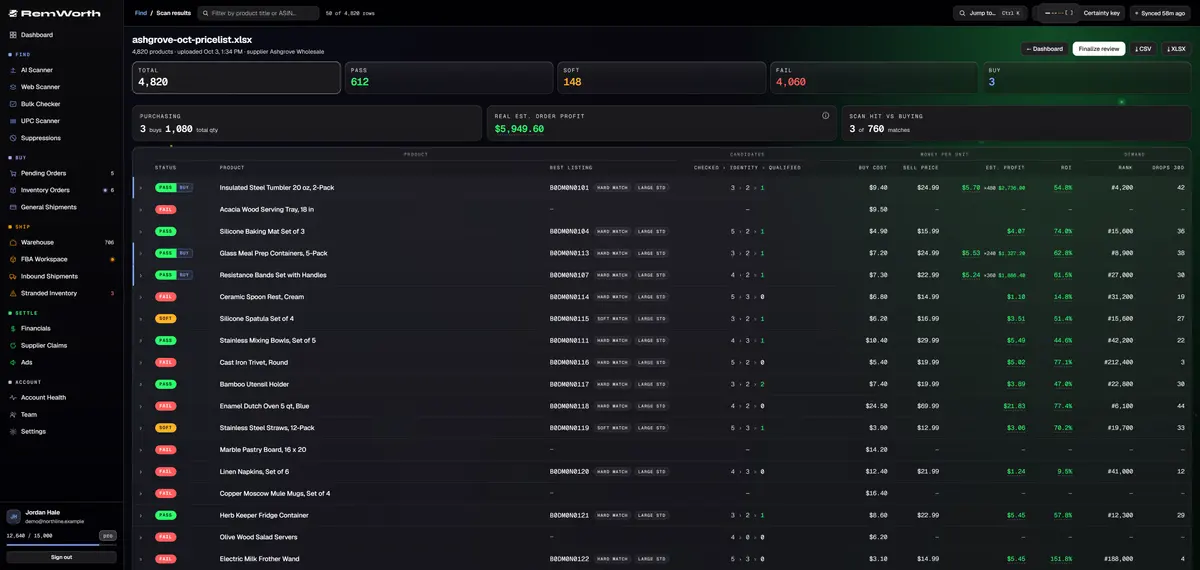
- Place the orderFinalize a scan and your buys land on Pending Orders, grouped by supplier. Tick the lines you're buying, enter the order number, card and cashback once, and confirm: that creates the purchase order, or adds to the one already under that order number. Orders placed by phone or at a trade show go in by hand and follow the same path. Paste the tracking number and the order shows the carrier's last scan and the ETA, and a calendar shows what lands each day.
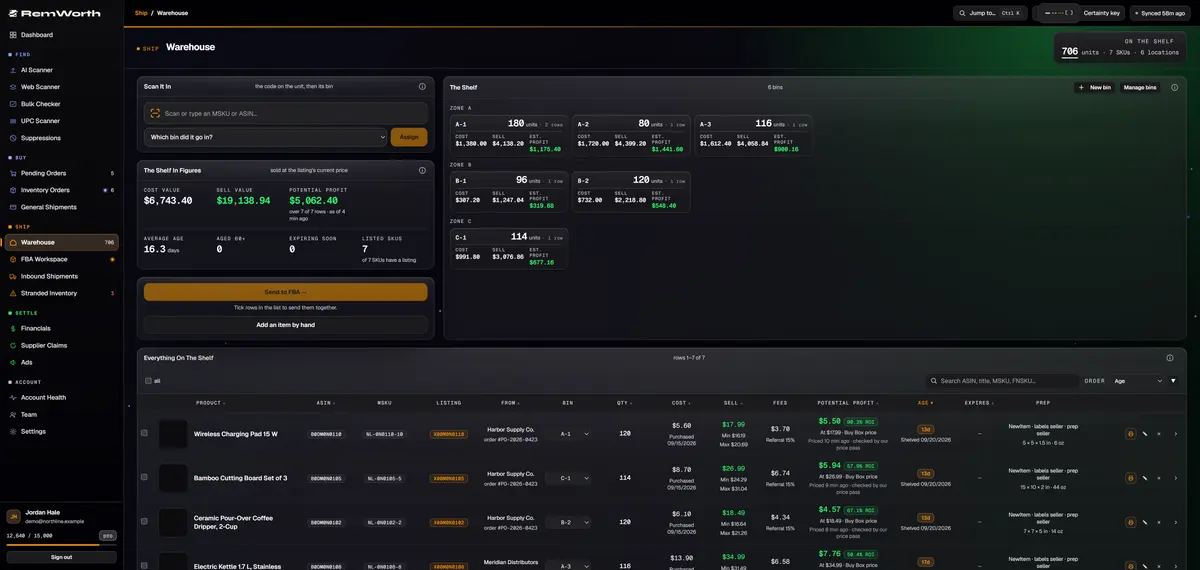
- Receive it by the caseCount each line good, damaged, expired or cancelled; case mode does the multiplying, so 3 cases of 6 is 18 units. Every unit is costed at the price on its order the moment you receive it, and damaged or expired units open a supplier refund case priced at what you paid.
- Label it and shelve itSince January 1, 2026, Amazon no longer offers prep and item labeling for US FBA, and since March 31, 2026, resellers must put Amazon barcodes on products even when they carry a manufacturer barcode. Remworth gets each FNSKU from Amazon and prints 2×1-inch labels straight from the browser. Stock you aren't sending yet waits in your warehouse, by zone, shelf and bin.
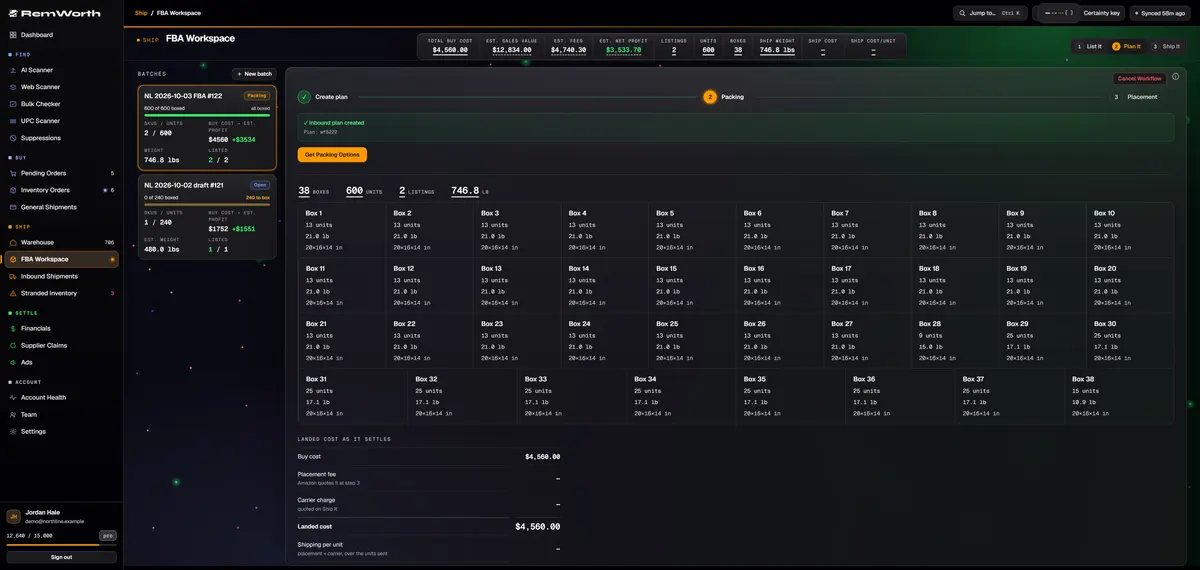
- Ship it to FBAPlan it, pack it, book it and ship it from one screen: Amazon's partnered small-parcel or pallet (LTL) quotes, or your own carrier. Gating is checked again at shipping time, and the freight is folded into each unit's cost when the shipment ships.
- Judge the supplier, not just the productAmazon's check-in counts are pulled automatically, so a short shipment shows up. On the profit side, the Suppliers view shows spend, gross profit, ROI, lead time and ASINs for each supplier, with its products ranked inside.
Wholesale vs arbitrage
Wholesale, online arbitrage or retail arbitrage?
All three resell products on Amazon listings. What changes is where you buy and what you check before you do. From the purchase order on, Remworth runs all three the same way.
| Wholesale | Online arbitrage | Retail arbitrage | |
|---|---|---|---|
| Where you buy | from the manufacturer or a wholesale supplier, in bulk | from online stores, often on sale or clearance | in retail stores, at lower prices |
| What you check | a supplier's price list | a list of Amazon products to find a store for, or a list of store products | the ASINs you hunt for, before the trip |
| Where Remworth starts | the UPC Scanner for barcode lists; the AI Scanner for lists without | the Web Scanner, which searches major retailers for a source for each Amazon product | the Bulk Checker, then each buy logged by hand with its receipt |
| In the 7-day trial | the UPC Scanner, the Bulk Checker, purchase orders and receiving by the case | the Bulk Checker and the UPC Scanner; the Web Scanner starts with paid AI scan rows | the Bulk Checker, logged buys, receiving, labels and FBA shipping |
| Read more | Wholesale price list analysis | Remworth for online arbitrage | Remworth for retail arbitrage |
Your first week
Your first week: one real supplier list.
The 7-day trial runs on your real Amazon account. Bring one supplier's price list with barcodes: nothing this week uses AI scan rows. Start the 7-day trial
- Day 1: connect AmazonMake the account with your email, pick a plan and add a card (nothing is charged in the 7 days), then connect your amazon.com seller account through Amazon's own consent flow.
- Day 1: run the price listTrial task: drop the supplier's sheet into the UPC Scanner, CSV or Excel, up to 5,000 rows. Quoted by the case? Add a Case Qty column. Each match comes back with price, rank, fees from Amazon's rate card and your profit per unit.
- Day 2: check what you can sellTrial task: open the scan's review page. Every match shows what your own account can sell: Ungated, Can apply, Restricted, or Checking if Amazon hasn't answered yet, and the page asks Amazon again about those when you open it. Can apply comes with Amazon's approval link when Amazon gives one; you apply.
- Write the orderMark your buys and finalize the review: they land on Pending Orders under the supplier. Tick the lines, enter the order number, card and cashback once, and the purchase order is made. Paste the tracking number and the order shows the carrier's last scan and the ETA.
- If it lands this week, receive itCount it in by the case; damaged or expired units open a refund case at what you paid. Receiving, the warehouse, labels and FBA shipping all work in the trial.
- Day 8: the plan startsUnless you cancel, the plan price starts on day 8 with its monthly AI scan rows, and lists without barcodes can go through the AI Scanner. Cancel before day 8 and you pay nothing.
Up close
One price list, from the sheet to the order.
CSV or Excel, up to 50 MB and 5,000 rows, headers in the first row. Title and price are required; a UPC on every row gives the most exact match.
Put the pack count in a Case Qty column and the case price is read per item: a $20.94 case of 6 is $3.49 an item.
The scan already checks every match. For ASINs from anywhere else, paste up to 500 here. Each ASIN comes back Ungated, Can apply or Restricted on your own account. A failed lookup is never shown as sellable.
Mark the buys on the review page, then finalize. They land on Pending Orders under the supplier, ready to order.
Built for wholesale-size buying
The details a wholesale account hits every week.
- Case prices
- a Case Qty column on your price list turns a case price into a per-item cost, in the AI Scanner and the UPC Scanner
- Multipacks
- when the Amazon listing is a multipack, your per-item cost is multiplied by its pack count
- Partial buys
- order 5 of 10 and the other 5 stay on the list, or close the line out
- Paper trail
- the supplier's PDF invoice attached to its purchase order
- Loose units
- singles from separate orders pool into complete sellable packs; the row reads "✓ 2 packs ready" or "partial · need 1"
- Pallets
- Amazon's partnered LTL quotes from your pallet count, dimensions, weight, freight class and declared value; or your own carrier, with the bill of lading captured
- Short at Amazon
- Amazon's check-in counts pulled automatically: shipped 60, checked in 57, and you see the 3
- Supplier refunds
- damaged or expired units open a case priced at what you paid; you contact the supplier, Remworth tracks the case to Refund Received
- Cost by order
- the same product bought at $4 in March and $6 in June books each sale at the right cost
- Money cycle
- purchase to sold out, timed: supplier lead time, your own turnaround, Amazon check-in and sell-through
Straight answers
What Remworth doesn't do for a wholesale business.
- It doesn't find suppliers or publish a list of Amazon-friendly wholesalers. It tracks the suppliers you already buy from.
- It isn't a product database or a list of the best wholesale products. It checks the price lists you bring.
- It doesn't apply for brand approval or chase suppliers for you. It links Amazon's application and keeps the refund case; you file the application and you contact the supplier.
- It covers amazon.com only, not Amazon's other marketplaces.
Go deeper
Questions
Amazon wholesale questions
What is the Amazon wholesale business model?
You buy branded products in bulk from the manufacturer or a wholesale supplier and resell them on Amazon, usually on listings that are already live. Your profit is the sale price minus Amazon's fees and your landed cost, so the work is buying right and keeping costs straight. With FBA, Amazon handles storage, packing, shipping, returns and customer service. Amazon's own wholesale guide also uses the word for selling to business customers through Amazon Business, which is included with the Professional selling plan. Remworth is built for the reselling side.
Do I need a special Amazon wholesale account?
You need an Amazon selling account. Amazon's wholesale guide says to have your business registration and licenses ready, sign up at sell.amazon.com, and choose the Professional selling plan, $39.99 a month. The Individual plan is $0.99 per item sold. Selling fees come on top of either plan.
How do I find Amazon wholesale suppliers?
Amazon's guide points to trade shows, referrals, professional networks and its own Service Provider Network. Vet each one: look up their office and warehouse locations, and ask about minimum order quantities, cost per unit and other costs like membership fees. If a product needs approval, you'll need a purchase invoice from a manufacturer or distributor, or a letter from the brand authorizing you to sell. Remworth doesn't find suppliers; once you buy, it tracks each one and the profit its stock makes.
What do I need to sell a brand that needs approval?
Amazon prompts you to complete a Selling application for the brand and asks for a purchase invoice from a manufacturer or distributor, or a brand authorization letter. Amazon's wholesale guide says to gather supplier invoices from the last 180 days showing at least 10 units purchased. Check the application itself for the current terms. Remworth's Bulk Checker shows which ASINs your account can apply for and links the application; you file it.
How do I analyze a wholesale pricing sheet?
Match every row to the right Amazon listing, turn case prices into a per-item cost, correct for multipacks, take off Amazon's referral and FBA fees, and check that your account can sell it. Barcode lists go through the UPC Scanner; lists without barcodes go through the AI Scanner. Both check gating on your own account while they scan. A match Amazon hasn't answered yet shows Checking and is never shown as sellable.
What are the best wholesale products to sell on Amazon?
No list holds for every account. A good wholesale product sells steadily, leaves profit after every fee, isn't gated for you, and isn't crowded with sellers. Amazon says Best Sellers Rank compares a product's sales with similar products, and recent sales count more than older ones, so read the rank history, not one snapshot. AI Scanner results show rank, rank drops, and Amazon's "bought in past month" figure when Amazon shows it. Remworth has no product database.
Do wholesale products sent to FBA need Amazon barcodes now?
Yes, if you're a reseller. Amazon ended commingling on March 31, 2026: resellers must use Amazon barcode stickers even when a product has a manufacturer barcode. Brand owners in Brand Registry are exempt for products that already carry one. Amazon also stopped offering prep and item labeling for US FBA on January 1, 2026. Remworth prints 2×1-inch FNSKU labels straight from the browser.
Can I try Remworth on my wholesale business?
Yes. The 7-day trial is free with a card on file and runs on your real Amazon account. The UPC Scanner, the Bulk Checker, purchase orders, receiving, the warehouse and FBA shipping all work in it. AI Scanner rows start with a paid plan.
Run your next supplier order through it.
Connect your Amazon account, check a price list with the UPC Scanner, gating included, and write the purchase order, all in the 7-day trial.
Solo $199.99/mo · Pro $349.99/mo · 7 days free, card required
On your phone? Start with just your email. The link we email you works once, on any device, within 7 days, and the app opens once you've picked a plan, added your card and connected your Amazon seller account.
Your Amazon password stays with Amazon. How Remworth connects.
Sources
- Amazon: How to sell wholesale on Amazon the Professional plan and Amazon Business; supplier invoices from the last 180 days showing at least 10 units
- Amazon: How to find wholesalers where to find wholesale suppliers, what to ask them, and the approval documents
- Amazon: 3 ways to sell branded products on Amazon buying from a wholesale supplier or manufacturer; the Selling application for Brand: an invoice or a brand authorization letter
- Amazon: Guide to reselling in Amazon stores matching listings that are already live; what FBA handles; plan prices plus selling fees
- Amazon: Selling plans and fees Individual $0.99 per item sold; Professional $39.99 a month
- Amazon: Best Sellers Rank BSR compares sales with similar products; recent sales count more
- Amazon Seller Forums announcement: commingling ends March 31, 2026 resellers must use Amazon barcodes; the Brand Registry exception
- Amazon Seller Forums announcement: US FBA prep and item labeling services no prep or item labeling services from January 1, 2026