FBA vs FBMAmazon ships it, or you do.
Price both before you choose.
FBA vs FBM comes down to who stores, packs and ships each order. With Fulfillment by Amazon (FBA), Amazon does it, for a fulfillment fee on each unit plus monthly storage. With Fulfilled by Merchant (FBM), you do it and pay your own postage. Here is what Amazon says each one costs and asks of you in 2026, with one sale worked through both ways.
- FBAAmazon ships, and handles service and returns
- FBMyou ship, and Amazon's shipping targets apply
- Prime badgeFBA, or Seller Fulfilled Prime
- Both at onceyes, with a SKU for each channel
FBA vs FBM: the short answer
With FBA, you send products into Amazon's fulfillment network. Amazon packs and ships each order and handles customer service and returns. You pay Amazon a fulfillment fee on each unit, plus monthly storage for the space your stock takes up.
With FBM, you keep the stock and ship each order to the buyer yourself. You pay your own postage and packaging, and Amazon holds you to shipping and tracking targets.
Neither is cheaper for every product. Amazon's own FBA vs FBM guide points to these things to weigh:
- Size and packing. Small products that need little packaging may be easier to ship yourself. Larger products may be harder to pack reliably, and Amazon says FBA can be a good way to make sure they are packed safely for transport.
- How much you sell. If you sell large volumes regularly, Amazon says FBA could be more sustainable. A small operation with seasonal products it can store and ship itself might do best in house.
- Access to your stock. Amazon says FBM might fit best if you need direct access to your inventory at all times, or have special packaging needs.
- Cost. FBA charges per unit and per order, by the product's weight and size and how long it is stored. With FBM, the shipping cost is yours.
You don't have to pick one for the whole business. Amazon says you can use either one, or both.
Who does each job
| The job | FBA | FBM |
|---|---|---|
| Storage | Amazon's fulfillment centers, billed monthly for the space | your own space |
| Pick, pack and ship | Amazon | you; Amazon sells labels through Amazon Buy Shipping |
| Customer service and returns | Amazon | you; Amazon automatically enrolls sellers in its prepaid return label program for US sales |
| Prime badge | products are eligible for Prime free two-day shipping | only through Seller Fulfilled Prime |
| Shipping targets | don't apply to FBA orders | late shipment, cancellation, valid tracking and on-time delivery |
| Negative feedback | feedback about Amazon's fulfillment or customer service can be struck through | counts toward your Order Defect Rate |
Sources: Amazon's FBA vs FBM guide, its FBA and FBM pages, and Seller Central Help.
One FBA detail to plan around: Amazon says inventory sent to a fulfillment center is usually scanned and available for sale within three business days of delivery. Plan for that gap when you restock.
Getting the Prime badge with FBM
Seller Fulfilled Prime puts the Prime badge on offers you ship yourself, with same-day, one-day and two-day delivery. Amazon lists three steps: get a Professional selling account, pre-qualify by meeting its performance requirements, and complete a 30-day trial.
The tracking bar is higher, too: 99% or more of Prime packages need valid tracking, across all your categories together.
Do you need FBA to win the Buy Box?
No. Amazon says fulfilling orders directly can be just as effective as its fulfillment network at improving your chances of becoming the Featured Offer. Offers with fast, free shipping and more certain delivery dates are more likely to be featured, whoever ships them. More in our Buy Box guide.
What each one costs
Some costs are the same both ways. Every sale pays a referral fee, and you pay for a selling plan: $0.99 per item sold on Individual, or $39.99 a month on Professional.
One difference: Amazon takes the referral fee on the total sales price, which includes any delivery charge the buyer pays. If you charge shipping on an FBM order, the referral fee applies to that charge too.
FBA fees
| FBA fee | What Amazon charges it for |
|---|---|
| Fulfillment | picking, packing and shipping each order, plus customer service and returns |
| Monthly storage | the space your inventory takes up in Amazon's fulfillment network |
| Aged inventory surcharge | items stored in a fulfillment center for more than 181 days, charged monthly |
| Inbound placement | distributing your inventory to fulfillment centers close to customers |
| Returns processing | orders where Amazon gives the customer free return shipping |
| Removal, disposal, liquidation | a per-item charge to send stock back, dispose of it or liquidate it |
Source: Amazon's Fulfillment by Amazon page. The main fees, with this year's figures, are in our 2026 fee guide.
FBA fee changes in 2026
- January 15: FBA fees rose by an average of $0.08 per unit sold, by Amazon's figure. No new FBA fee types this year.
- April 17: a 3.5% fuel and logistics surcharge on FBA fulfillment fees, not on the sale price. Amazon puts the average at $0.17 per unit and calls it temporary, but has given no end date.
- October 15, 2026 to January 14, 2027: holiday peak fulfillment fees, about $0.32 per unit above non-peak on average, with the 3.5% surcharge on top.
FBM costs
FBM orders don't pay FBA's fulfillment or storage fees. Your costs are postage, boxes and mailers, the space the stock takes up, and the time it takes to pack orders.
Amazon Buy Shipping lets you buy and print labels for UPS, FedEx, USPS and other carriers in one place. Amazon says its pre-negotiated rates average over 31% below retail ground rates for UPS, FedEx and USPS.
Amazon's Revenue Calculator compares estimates for FBA and your own fulfillment on a specific product. Give it your real postage cost, not a guess.
One sale, worked through both ways
Here is the same product sold once through FBA and once through FBM. The 15% referral rate is Amazon's Home and Kitchen rate. Every other figure is an example input, not Amazon's fee for a real product.
| Line | FBA | FBM |
|---|---|---|
| Sale price | $19.99 | $19.99 |
| Referral fee (15%) | −$3.00 | −$3.00 |
| FBA fees: fulfillment $4.50, this unit's storage $0.08 | −$4.58 | none |
| Getting it to Amazon: shipping in $0.40, poly bag and FNSKU label $0.25 | −$0.65 | none |
| Getting it to the buyer: postage $4.75, mailer $0.35 | none | −$5.10 |
| Your buy cost | −$8.00 | −$8.00 |
| Profit per unit | $3.76 | $3.89 |
- The two land 13 cents apart, so a small change in your postage or in the item's FBA fee decides it.
- The FBM figure leaves out your time packing each order and the space the stock takes up.
- The FBA storage line grows the longer a unit sits. Units stored more than 181 days add the aged inventory surcharge.
- From October 15, 2026 to January 14, 2027, the fulfillment fee would carry Amazon's holiday peak rate.
What FBM asks of you: Amazon's shipping targets
When you ship orders yourself, Amazon measures how well you do it. These targets apply only to seller-fulfilled orders. FBA orders don't count toward them.
| Target | What it counts | Amazon's bar |
|---|---|---|
| Order Defect Rate | orders with negative feedback, an A-to-z Guarantee claim or a credit card chargeback, over 60 days | under 1% |
| Late Shipment Rate | orders with no shipment confirmation by the expected ship date, over 10 and 30 days | under 4% |
| Cancellation rate | orders you cancel, over 7 days | under 2.5% |
| Valid Tracking Rate | packages with a valid tracking ID | 95%, per product category |
| On-Time Delivery Rate | tracked items delivered by the "Deliver by" date your handling and transit times set | at least 90%; Amazon recommends 95% |
Source: Amazon's Order Performance policy and its metric pages in Seller Central Help. The policy page words the tracking target "greater than 95%"; the tracking page says "greater than or equal to 95%".
The stakes are real: Amazon says a late shipment or cancellation rate above target may lead to suspension of your FBM selling privileges, or deactivation of your seller-fulfilled offers.
New in 2026: accurate handling time
Handling time is the time from receiving an order to handing the package to the carrier. Starting June 29, 2026, Amazon requires the handling time on each seller-fulfilled SKU to match how fast you actually ship.
Amazon recommends Automated Handling Time, switched on in Shipping settings. It sets handling times from your recent shipping history and comes with late shipment rate protection.
What FBA asks of you in 2026
FBA takes shipping to buyers off your hands. The work before your shipment reaches Amazon is still yours. Here is what that means this year:
- Prep and labels are your job. From January 1, 2026, Amazon stopped offering prep and item labeling services for US FBA.
- Every unit needs an Amazon barcode. Amazon ended commingling on March 31, 2026. Resellers must now use Amazon barcode stickers (the FNSKU) even when a product has a manufacturer barcode. Brand representatives in Brand Registry are exempt for products that already carry one.
- Bad prep costs you. An Amazon staff reply says products without proper prep, or with missing or defective labels, are flagged as defects and aren't eligible for reimbursement.
Since October 17, 2022, Amazon has required every new FBA shipment to be created in its Send to Amazon workflow or through its APIs.
Capacity limits
FBA limits how much you can store. Individual selling accounts get a fixed capacity limit of 15 cubic feet that can't be raised. New Professional accounts, active in FBA for less than 39 weeks, get no capacity limits while they build a sales record.
Using both: one product, two channels
You can sell the same product through FBA and FBM at the same time.
Amazon's way: give each channel its own SKU, rather than switching one SKU back and forth. In Manage Inventory, choose Add another condition on the listing, create a new SKU for the offer, and set its fulfillment channel. Amazon suggests adding -FBA to the end of the FBA one.
- Product by product. Price each one both ways, and send it where it makes more.
- Units on your shelf. Units you still hold can sell under their own FBM SKU while others are on their way to Amazon.
Amazon's Multi-Channel Fulfillment (MCF) works the other way round: it lets FBA fill orders placed on your own website and other sales channels.
Before you choose, check these for each product
- The FBA fee against your postage. Get the item's FBA fee from the Revenue Calculator, and compare it with what a label to a buyer really costs you.
- How fast it sells. Storage is billed monthly, and units stored more than 181 days add the aged inventory surcharge. A slow seller pays more storage in FBA.
- Who holds the Buy Box. See whether FBA or FBM sellers have been winning it, and at what price.
- Whether you can hit FBM's targets. Shipping on time, with valid tracking, every day you have orders.
- Your space and your time. FBM needs room for the stock and hours to pack it.
- The season. FBA's holiday peak fulfillment fees run from October 15, 2026 to January 14, 2027.
Where Remworth fits
Remworth is software for US Amazon resellers. It prices products both ways before you buy, and runs the FBA shipment once you do. It doesn't ship FBM orders.
- FBA and FBM side by side. Every product in an AI Scanner or UPC Scanner review has a Profitability box with an FBA column and an FBM column: net, ROI and margin each way. Switch the view to All, FBA or FBM. Type your postage into the FBM column's ship-to-buyer line; it starts from the ship-to-buyer estimate saved in your Settings (the USPS price list, a rate per pound, or a flat cost per sale), or $0.00 if there isn't one.
- FBM pricing for whole scans. If you mostly ship yourself, set your fulfillment channel to FBM in Settings and choose how the label to the buyer is estimated: the USPS price list, a rate per pound, or your average shipping cost per sale. New AI, Web and UPC scans then price products as FBM. Remworth won't switch to FBM with a flat cost or a per-pound rate left empty, so FBM scans don't count shipping to the buyer as free. What you charge the buyer for shipping, set in the same place, counts as income.
- Who sells it, FBA or FBM. The AI Scanner review splits a listing's live offers into FBA and FBM, with the stock and lowest price on each side. Its Buy Box history filters to FBA or FBM sellers and shows each side's share.
- The FBA shipment. When FBA wins, Remworth runs Amazon's Send to Amazon steps from the units you have received: FNSKU labels from the browser, packing and placement options, Amazon partnered small-parcel or LTL quotes or your own carrier, box labels, and Amazon's check-in counts afterward. See FBA shipping.
It doesn't buy postage, print FBM shipping labels or confirm shipment on FBM orders. You handle those in Seller Central, or in a shipping tool of your choice.
In the 7-day trial, the UPC Scanner works from day one: run a supplier's barcode list, and price each match both ways with your own postage cost. AI scan rows start with a paid plan.
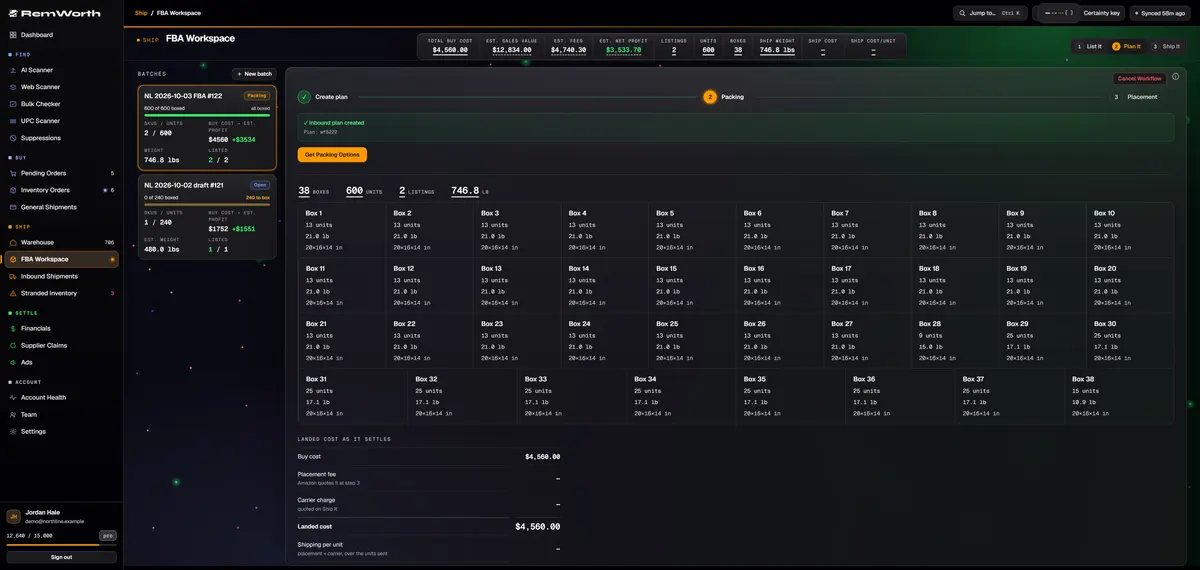
Shipping with FBA
Questions
FBA vs FBM questions
What is the difference between FBA and FBM?
With FBA, you send stock to Amazon's fulfillment centers, and Amazon packs, ships, and handles customer service and returns, for a fulfillment fee on each unit plus monthly storage. With FBM, you store the stock and ship each order yourself, pay your own postage, and meet Amazon's shipping targets for seller-fulfilled orders.
Is FBA or FBM more profitable?
Neither one wins for every product. It depends on the item's FBA fee against your real postage, how fast it sells, and your own time and space. Price each product both ways. Amazon's Revenue Calculator compares the two, and Remworth's AI Scanner and UPC Scanner reviews show FBA and FBM profit side by side for every product.
Can I use FBA and FBM at the same time?
Yes. Amazon says you can offer the same product through both channels at once by creating a separate SKU for each channel, rather than switching one SKU back and forth.
Can FBM sellers get the Prime badge?
Yes, through Seller Fulfilled Prime. Amazon lists three steps: a Professional selling account, pre-qualifying by meeting its performance requirements, and a successful 30-day trial. At least 99% of Prime packages need valid tracking.
Do I need FBA to win the Buy Box?
No. Amazon says fulfilling orders directly can be just as effective as its fulfillment network at improving your chances of becoming the Featured Offer. Fast, free shipping and more certain delivery dates help either way.
What performance targets do FBM sellers have to meet?
Order Defect Rate under 1%, Late Shipment Rate under 4%, cancellation rate under 2.5%, a Valid Tracking Rate of 95% per category, and an On-Time Delivery Rate of at least 90%. Since June 29, 2026, Amazon also requires accurate handling times on seller-fulfilled SKUs. None of these apply to FBA orders.
What does FBA cost in 2026?
A fulfillment fee per unit, monthly storage, an aged inventory surcharge after 181 days, an inbound placement fee, and fees for returns processing and removals. Amazon says FBA fees rose by an average of $0.08 per unit on January 15, 2026, a 3.5% surcharge on fulfillment fees started April 17, and holiday peak fees run from October 15, 2026 to January 14, 2027. The referral fee and your selling plan apply either way.
Does Remworth ship FBM orders?
No. Remworth prices products as FBM, side by side with FBA, and runs your FBA shipments. It doesn't buy postage, print FBM shipping labels or confirm shipment on FBM orders; you handle those in Seller Central, or in a shipping tool of your choice.
Price your next buy both ways.
Connect your Amazon seller account, run a supplier's barcode list through the UPC Scanner, and see FBA and FBM profit for each match, with your own postage cost. When FBA wins, ship it from the same app.
Solo $199.99/mo · Pro $349.99/mo · 7 days free, card required
On your phone? Start with just your email. The link we email you works once, on any device, within 7 days, and the app opens once you've picked a plan, added your card and connected your Amazon seller account.
Your Amazon password stays with Amazon. How Remworth connects.
Sources
- Amazon: Amazon FBA vs FBM: Which is right for you? (Oct 18, 2024) what FBA and FBM are; product size, sales volume and access to inventory; how FBA is charged; Seller Fulfilled Prime's three steps; using one or both; Multi-Channel Fulfillment
- Amazon: Fulfilled by Merchant what FBM sellers do; Amazon Buy Shipping and its average rates; the prepaid returns label program; Seller Fulfilled Prime delivery speeds
- Amazon: Fulfillment by Amazon what FBA does; the FBA fee types; the Revenue Calculator compares FBA and your own fulfillment
- Amazon: Maximize your sales potential with the Featured Offer (Apr 10, 2026) fulfilling directly can be just as effective; fast, free shipping and delivery certainty
- Amazon: Revenue Calculator fee estimates for a product, FBA and your own fulfillment
- Seller Central Help: Get started with Fulfillment by Amazon Prime free two-day eligibility; Amazon customer service and returns; one product through both channels, with a SKU for each
- Seller Central Help: FBA policies and requirements negative feedback about Amazon's fulfillment or customer service can be struck through
- Seller Central Help: Ship products to Amazon stock usually available within three business days of delivery; Send to Amazon or the APIs since October 17, 2022
- Seller Central Help: FBA capacity limits 15 cubic feet for Individual accounts; no limits for new Professional accounts under 39 weeks in FBA
- Seller Central Help: Selling on Amazon fee schedule plan fees; the referral fee on the total sales price, delivery charges included; Home and Kitchen at 15%, $0.30 minimum
- Seller Central Help: Order Performance program policy the five targets; the handling time requirement from June 29, 2026; On-Time Delivery Rate doesn't apply to FBA
- Seller Central Help: Order Defect Rate the three defects; 60 days; seller-fulfilled orders only
- Seller Central Help: Late Shipment Rate under 4%; seller-fulfilled only; FBM privileges or offers at risk
- Seller Central Help: Cancellation rate under 2.5% over 7 days; seller-fulfilled only; FBM privileges or offers at risk
- Seller Central Help: Valid tracking rate (VTR) 95% per category; FBA listings not affected; 99% for Seller Fulfilled Prime packages
- Amazon Seller Forums: prep and item labeling services end January 1, 2026 no Amazon prep or item labeling for US FBA
- News_Amazon: Commingling practices will end effective March 31, 2026 Amazon barcodes on reseller units; the Brand Registry exception
- Amazon staff reply (Bryce_Amazon) on unprepped and unlabeled units defects, and no reimbursement
- News_Amazon: 2026 updates to US referral and FBA fees average $0.08 per unit increase from January 15, 2026; no new FBA fee types
- Amazon Seller Forums: fuel and logistics surcharge 3.5% on fulfillment fees from April 17, 2026; about $0.17 per unit on average
- Amazon Seller Forums: Holiday 2026 fees and deadlines peak fulfillment fees October 15, 2026 to January 14, 2027, about $0.32 per unit on average, surcharge on top