Amazon inventory placement feeThe fee, the freight, the prep.
Counted before you ship.
Amazon's inventory placement fee (officially the inbound placement service fee) is charged 45 days after your units are received, long after you decided the buy was worth it. Remworth shows it while you build the shipment, beside your buy cost and carrier charge, so you know a batch's landed cost before it ships. Your scans count prep and freight before you buy, and your profit books the fee from Amazon's own bill.
- Placement feeAmazon's offers side by side, before you pick
- Freightspread across the units on each shipment
- Prepyour per-unit costs in every projection
- Check-inshipped vs received
One batch, start to finish
From the first box to Amazon's check-in count.
Start a batch as five identical boxes or one mixed box. A mixed-box batch carries a PF (placement fee) tag, so you plan for the fee from day one. Each batch card shows its units, buy cost and estimated profit.
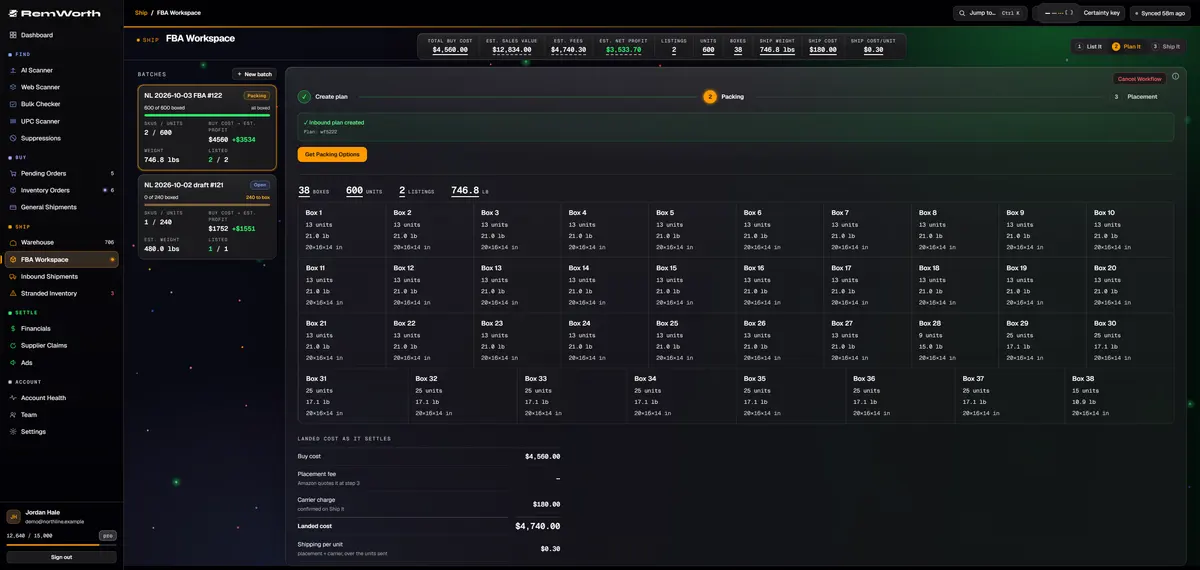
Every box carries its units, weight and size, with the batch totals on top. These confirmed boxes are what Remworth sends to Amazon when you plan the shipment.
Landed cost starts at your buy cost. Amazon's placement fee joins it when Amazon quotes it at the placement step, and the carrier charge when you confirm it on Ship It. You get the landed total and the shipping cost per unit sent.
Total buy cost, estimated sales value, estimated Amazon fees and estimated net profit, with ship cost and ship cost per unit beside them: the carrier charge plus Amazon's placement fee.
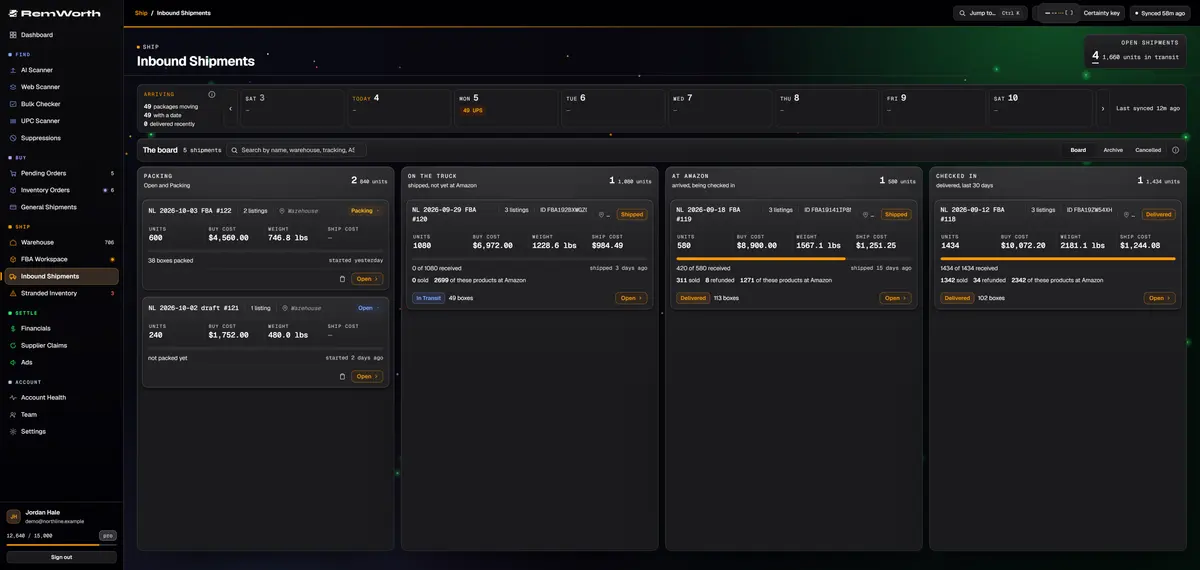
Each card shows units, buy cost, weight and ship cost. Open it for the cost card: product cost, carrier, placement fee, cost per unit and estimated profit. An Amazon partnered charge is locked; your own carrier's stays editable.
Remworth pulls Amazon's received count and shows shipped against received, per product, per shipment. If a shipment comes in short, print the reimbursement claim with its evidence and file it with Amazon.
Amazon FBA inbound fees and your costs
Every inbound cost, and where it lands.
Some costs are your estimates while you decide what to buy. Some are Amazon's quotes while you ship. Some are Amazon's bill afterward. Remworth keeps each one in its place.
- Buy cost
- locked per supplier order the day you receive it; each sale draws it first in, first out
- Prep
- your per-unit bag, tape, label, bubble wrap and other costs, in every profit projection
- Ship to FBA, estimated
- your dollars-per-pound rate, in every projection before you buy
- Placement fee, estimated
- switch it on in Settings and projections include it, by weight and by how many locations you split a shipment across
- Placement fee, quoted
- Amazon's offers at the placement step: the fee, the cost per unit and the warehouses for each
- Placement fee, billed
- booked into profit from Amazon's own bill
- Carrier charge
- spread across the sellable units of the shipment the moment it ships, every leg counted when Amazon splits it
- Partnered charges
- locked read-only, because Amazon's bill is the truth
- Late freight invoice
- edit your own carrier's charge after shipping and the per-unit share updates
- In your profit
- freight is its own line, subtracted in the period the shipment ships, never left out
How to avoid Amazon placement fees
Pay less placement fee, or none.
Amazon charges the fee to cover distributing your stock to fulfillment centers close to customers. It says you can pay a reduced fee, or no fee, depending on whether you send a shipment to a single location or to multiple locations (Amazon's announcement). And it offers placement options only when a shipment qualifies.
- Keep the boxes identicalAmazon's staff advise the same item mix and the same quantities in every box, and separate shipments for standard-size, non-standard-size and special-handling items. In Remworth, start the batch with the five-identical-boxes layout.
- Stage until you have enoughShort on units of an ASIN? From Inventory Orders, choose Send to FBA, then Stage for identical boxes. Remworth flags each ASIN that is ready to batch into a shipment built for Amazon's no-fee option.
- Compare what Amazon offersAt the placement step, Remworth lists Amazon's placement offers side by side: the fee, the cost per unit, how many shipments, and the warehouses on a map. The lowest fee is marked.
- Price the whole tripEach offer shows how many shipments it makes, and each shipment gets its own carrier quote. Remworth carries the placement fee, then the carrier charge, into the batch's landed cost and estimated net, so you see the whole trip and not just the fee.
Landed cost per unit
Still working out landed cost in a spreadsheet?
A spreadsheet can divide a freight bill. It can't pull Amazon's placement offers, or notice that Amazon checked in fewer units than you sent.
Straight answers
What it doesn't do.
- It can't make Amazon offer a no-fee placement option. Amazon offers placement options only when a shipment qualifies; Remworth shows the ones you get and helps you batch toward the no-fee one.
- Your profit doesn't spread the placement fee into each unit's cost. The Workspace shows the fee per unit while you plan; profit books it from Amazon's own bill.
- It doesn't split freight by Amazon's check-in count. Freight follows the units on the shipment, and Amazon's count is tracked beside it.
- Placement fee estimates in your scans are off until you switch them on in Settings.
- It doesn't file reimbursement claims with Amazon. It prints the claim and its evidence; you file it.
- It isn't a prep service. Amazon stopped offering prep and item labeling services for US FBA on January 1, 2026. Remworth counts your prep cost; your team or prep center does the work.
Next in the workflow
Questions
Placement fee and landed cost questions
What is the Amazon inventory placement fee?
It is Amazon's inbound placement service fee: a per-unit charge on standard-size and large bulky products that covers Amazon's cost of distributing your inventory to fulfillment centers close to customers. Amazon charges it 45 days after your products are received. Amazon says you can pay a reduced fee, or no fee, depending on whether you send a shipment to a single location or to multiple locations. For rates and details, Amazon points sellers to its Inbound Placement Service Fee page in Seller Central.
How do I avoid Amazon placement fees?
Amazon says you can pay a reduced fee, or no fee, depending on whether a shipment goes to a single location or to multiple locations, and it offers placement options only when a shipment qualifies. Its staff advise the same item mix and quantities in every box, and separate shipments for standard-size, non-standard-size and special-handling items. In Remworth you start a batch as five identical boxes, stage units until an ASIN is ready, and pick from Amazon's offers with the fee and the number of shipments shown on each. New Professional sellers: Amazon advertises a $400 credit for inbound placement costs (Amazon's FBA page).
How do I calculate landed cost per unit for Amazon?
Start with what you paid per unit after discounts, cashback and sales tax. Add your prep cost per unit. Then add the shipment's carrier charge and Amazon's placement fee, divided by the units on the shipment. The FBA Workspace shows that last part as shipping per unit. Your scans project buy cost, prep and freight before you buy, plus the placement fee once you switch it on in Settings.
What is included in landed cost for Amazon FBA?
Everything it takes to get a unit onto Amazon's shelf: the buy cost after discounts and cashback, sales tax, prep materials, freight to Amazon, and Amazon's inbound placement fee. Amazon stopped offering prep and item labeling services for US FBA on January 1, 2026, so prep is a cost you count yourself.
Landed cost vs COGS: what is the difference?
Landed cost is what one unit costs you by the time it reaches Amazon. Cost of goods sold (COGS) is the cost of the units you actually sold in a period. In Remworth's profit, COGS is what you paid for each unit, first in, first out. Inbound freight is its own line, subtracted in the period the shipment ships, and the placement fee comes from Amazon's bill. How you report freight for taxes is a question for your accountant.
Does Remworth include the placement fee in my profit?
Yes. Scan projections include it once you switch it on in Settings. The FBA Workspace and each shipment's cost card show the fee Amazon quoted. Your profit books the fee from Amazon's own bill, so the number is Amazon's, not an estimate.
What happens if Amazon checks in fewer units than I shipped?
You see it. Remworth pulls Amazon's received count and shows shipped against received, per product, per shipment. When a shipment comes in short, Remworth prints the reimbursement claim with its evidence. Filing it with Amazon is up to you.
Can I choose which Amazon warehouse my shipment goes to?
You choose among the placement offers Amazon makes, and each offer comes with its own warehouses and fee. Remworth shows each offer's warehouses on a map beside its fee, then handles every destination's carrier quote, tracking and labels.
See your next batch's landed cost before it ships.
Connect your Amazon account, send your received units to the FBA Workspace, and see the placement fee, the freight and Amazon's check-in count in one place.
Solo $199.99/mo · Pro $349.99/mo · 7 days free, card required
On your phone? Start with just your email. The link we email you works once, on any device, within 7 days, and the app opens once you've picked a plan, added your card and connected your Amazon seller account.
Your Amazon password stays with Amazon. How Remworth connects.
Sources
- Amazon: Update to US referral and Fulfillment by Amazon fees (Dec 5, 2023) the inbound placement service fee: a per-unit fee on standard and large bulky products, why it exists, that it is charged 45 days after products are received, and that a single location or multiple locations decides a reduced fee or no fee
- Amazon: 2025 updates to US referral and FBA fees (Nov 19, 2024) Amazon points sellers to its Inbound Placement Service Fee page in Seller Central for the details
- Sell on Amazon: Fulfillment by Amazon placement covers distributing standard and large bulky inventory to fulfillment centers close to customers; the $400 inbound placement credit for new Professional sellers
- Amazon staff reply (Jameson_Amazon), Seller Forums placement options are offered only when a shipment qualifies; keep item mix and quantities equal across boxes
- Amazon staff reply (KJ_Amazon), Seller Forums separate shipments for standard-size, non-standard-size and special-handling items; equal item mix and quantities across boxes
- Amazon: prep and item labeling services end Jan 1, 2026 Amazon no longer offers prep and item labeling services for US FBA