EAN vs UPCTwelve digits or thirteen.
Amazon's catalog carries both.
EAN vs UPC: a UPC is a 12-digit barcode number used mostly in North America. An EAN is a 13-digit number used across Europe and much of the rest of the world. Both are GTINs in the GS1 system, and Amazon's catalog uses both. Below: the leading zero, the prefix myth, and a supplier list that mixes the two.
- UPC12 digits · mostly North America
- EAN13 digits · much of the rest of the world
- Both areGTINs in the GS1 system
- On Amazonboth among the most used product IDs
EAN vs UPC at a glance
| UPC | EAN | |
|---|---|---|
| Stands for | Universal Product Code | European Article Number |
| Digits | 12 | 13 |
| GS1 name | GTIN-12 | GTIN-13 |
| Mostly used in | North America | Europe and much of the rest of the world |
| Barcode it prints in | UPC-A | EAN-13 |
| Written in 13 digits | add a 0 in front; still the same number | already 13; a real one never starts with 0 |
| Who assigns it | the brand owner, with a U.P.C. Company Prefix from GS1 | the brand owner, with a GS1 Company Prefix |
Sources: GS1 US and GS1 support pages and the GS1 US GTIN guideline, all listed below.
The number and the barcode are two different things. GS1 calls the number a GTIN, a Global Trade Item Number: it is the number printed under the black and white lines. UPC-A and EAN-13 are the barcodes that carry it.
GTINs come in 8, 12, 13 and 14 digits. The 8-digit kind is for small items, and the 14-digit kind is for cases and packaging.
Neither one is tied to the shelves of one country. GS1 US says UPCs and EANs can both be used internationally, and GS1 says all GTIN formats are usually accepted by marketplaces and retailers around the world.
The leading zero: a UPC written in 13 digits
This is where EAN and UPC get mixed up. GS1's format for databases is a 14-digit field, filled with zeros on the left. In GS1's own example, the UPC 614141000005 is stored as 00614141000005. The zeros in front don't change the number.
GS1 also says a company prefix used to make a GTIN-13 starts with 1 to 9. Put the two together:
- A 13-digit code that starts with 0 is a UPC with a zero in front. Drop the zero and you have the 12-digit UPC.
- To turn a UPC into a 13-digit code, add a 0 in front. Same product, same number.
- A real EAN can't be cut to 12 digits. It never starts with 0, so there is no zero to drop. Removing any other digit makes a different number.
| Written as | Digits | Example |
|---|---|---|
| A UPC, as printed under a UPC-A barcode | 12 | 614141000005 |
| The same UPC, padded to 13 digits | 13 | 0614141000005 |
| The same UPC, in a 14-digit database field | 14 | 00614141000005 |
Example number from GS1 US, "An Introduction to the Global Trade Item Number (GTIN)", Release 2.1, July 2021.
When a spreadsheet eats the zero
A spreadsheet that treats the barcode column as numbers drops leading zeros. A 12-digit UPC that starts with 0 comes out as 11 digits, and it is no longer a UPC as typed. Format the barcode column as text before you paste, or use a tool that puts the zero back.
What the first digits do and don't tell you
The first few digits of an EAN-13 are its GS1 Prefix. They show which GS1 Member Organization allocated the number. GS1's own answer to the country question is short:
No, The GS1 Prefix does not show the country of origin.
GS1 support, "Does the GS1 Prefix (first 3 or 4 digits of the EAN-13 barcode number) show the country of origin?"
GS1 adds that the product may have been made anywhere in the world. So an EAN on a product in a US store doesn't mean it was made abroad, and a UPC doesn't mean it was made in the US.
What Amazon asks for instead
When Amazon questions where your stock came from, it asks for your supplier invoices. Its invoice requirements for appeals say an invoice must show clear product identifiers: product names, model numbers, or a UPC, EAN or ISBN. It is worth asking suppliers to print the barcode number on every invoice line. More in invoices that pass an Amazon appeal.
UPC or EAN on Amazon: what a reseller needs
For most categories, Amazon requires a unique product ID, a GTIN, to create a new listing. Which GTIN it requires varies by category. UPC, ISBN, EAN and JAN are the most commonly used in its catalog.
Reselling a product that is already on Amazon doesn't take a new listing. Amazon's ASIN creation policy says that to sell a product already available on Amazon, you add an offer to the existing ASIN. Its GTIN guide adds that when you find a matching product, you can add your offer without a GTIN.
Do you need to buy UPCs?
Not to resell a brand's product. GS1 says GTINs are assigned by the brand owner, so the UPC or EAN on the package is the brand's. Amazon says that if you create and own a new product yourself, you get a GTIN through GS1.
If you ever need your own, get them from GS1. Amazon checks UPCs against the GS1 database and treats a UPC that doesn't match GS1's information as invalid. It tells sellers to get UPCs directly from GS1, not from third parties selling UPC licenses, and says listings with invalid UPCs will be removed and may cost a seller its ASIN creation or selling privileges.
Singles, multipacks and cases each have their own
Amazon treats an item sold singly and a pack of that item as different sellable units, each with its own product ID. In most categories a multipack needs its own UPC and an item package quantity. A bundle of different products needs its own UPC or EAN. GS1 says the same: a unique GTIN for the unit, the multipack and the case.
That matters when you match a supplier's code. The UPC on a single belongs to the single. A 6-pack listing should carry a different code.
A 14-digit code that starts with 1 to 9 is a GTIN-14, which GS1 says is used for cases and packaging and can't be printed in a UPC or EAN barcode. It identifies a grouping of items, such as a case, not the single unit. Ask the supplier for the unit's UPC or EAN. A 14-digit code that starts with 0 is a shorter GTIN padded with zeros.
Use the code that is on the item
Amazon says sellers must use the correct product ID for the item they list, and it prohibits false product identification information, including UPC codes.
The barcode on the package isn't your FBA label
Amazon's FBA barcode page names two kinds of barcode: manufacturer barcodes, such as UPC, EAN, JAN and ISBN, and Amazon barcodes, the FNSKU labels that start with X. As of March 31, 2026, Amazon requires resellers to use Amazon barcodes even when a product has a manufacturer barcode.
So the UPC or EAN finds you the listing, and an FNSKU label goes on each unit you send to FBA. More in FNSKU labels are now required for resellers.
A supplier list with both: how to match it
Some wholesale price lists mix 12-digit UPCs, 13-digit EANs and 14-digit case codes. Get the codes right before you look them up:
- Keep the barcode column as text, so no leading zeros are lost.
- Leave each code as it is. Don't cut EANs to 12 digits. A 13-digit code that starts with 0 is a UPC either way.
- Swap case codes for unit codes. Ask the supplier for the unit UPC or EAN behind any 14-digit case code.
- Then check each match: the same product, the same pack, a barcode that is on the listing, your account's right to sell it, and the fees. The ASIN guide walks through those five checks.
Remworth's UPC Scanner does the lookup for a whole list: up to 5,000 rows a file, as CSV or XLSX. Put every barcode, UPC or EAN, in one column headed UPC. Each code is looked up on Amazon as a UPC, an EAN or a GTIN by its length, through your own seller account.
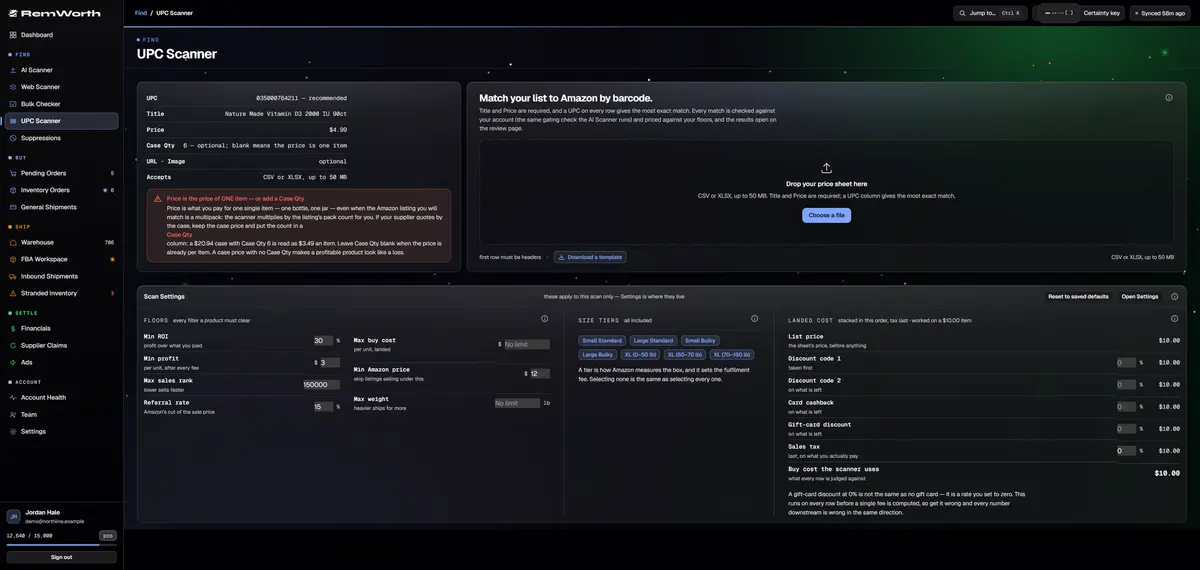
In Remworth
What the UPC Scanner does with each code.
It comes with every plan, uses no AI scan rows and works in the 7-day free trial (card required).
- 12 digits
- looked up on Amazon as a UPC
- 13 digits
- looked up as an EAN
- 14 digits
- looked up as a GTIN
- A UPC that lost its zeros
- put back to 12 digits and looked up as a UPC
- Spaces or dashes
- ignored
- No code, or no hit
- a title search instead
- On each match
- the UPC, EAN and GTIN codes on file for that listing, with a copy button, and whether your code is one of them. A leading zero doesn't make it a different code.
- Packs
- a multipack listing multiplies your unit cost by its pack count. "Pack unverified" means no pack size was found, so it is priced as one unit.
- Money
- the current Amazon price and rank, Amazon's referral and FBA fees, and your profit against your own buying rules
Straight answers
What it won't do with a barcode.
- It doesn't sell barcodes or check whether a code is registered with GS1. For your own products, Amazon says to go to GS1.
- It can't turn a case code into a unit code. Ask your supplier for the unit UPC or EAN.
- It doesn't scan store shelves. It reads files. For a barcode on a store shelf, Store Mode, part of Lens, scans from your phone's browser, with nothing to install.
Next
Questions
EAN and UPC questions
What is the difference between EAN and UPC?
A UPC is 12 digits and used mostly in North America. An EAN is 13 digits and used across Europe and much of the rest of the world. Both are GTINs in the GS1 system, and both print as barcodes that stores scan at checkout.
Can I use an EAN instead of a UPC on Amazon in the US?
Amazon lists both UPC and EAN among the most commonly used product IDs in its catalog, and which ID it requires varies by category. If you are adding your offer to a product already on Amazon, Amazon says you can do it without a GTIN.
How do I convert a UPC to an EAN?
Add a 0 in front. GS1's database format fills GTINs with zeros on the left, so 614141000005 and 0614141000005 are the same number. You can only go the other way when a 13-digit code starts with 0. A real EAN never does.
Do the first digits of an EAN show the country of origin?
No. GS1 says the prefix shows which GS1 Member Organization allocated the number, not where the product was made. It may have been made anywhere in the world.
Do I need to buy UPC codes to resell on Amazon?
Not to resell a brand's product. GS1 says the brand owner assigns its GTINs, and Amazon says you can add an offer to an existing listing without one. If you make your own product, Amazon says to get UPCs directly from GS1. It checks UPCs against the GS1 database and treats a code that doesn't match as invalid.
Why does my supplier's list have 14-digit codes?
A 14-digit code that starts with 1 to 9 is a GTIN-14, which GS1 says is used for cases and packaging. It identifies a grouping of items, such as a case, not the single unit, so ask the supplier for the unit UPC or EAN. A 14-digit code that starts with 0 is a shorter code padded with zeros.
Can the UPC Scanner read EANs?
Yes. Put UPCs, EANs and 14-digit GTINs in the same column headed UPC. The scanner looks each one up by its length (12 digits as a UPC, 13 as an EAN, 14 as a GTIN) and puts back the zeros a spreadsheet dropped from a UPC. Rows with no code fall back to a title search.
Is the UPC the barcode I use for FBA?
Not if you resell. As of March 31, 2026, Amazon requires resellers to use Amazon barcodes, the FNSKU labels, even when a product has a manufacturer barcode such as a UPC or EAN.
Bring the barcode list, UPCs and EANs together.
Upload up to 5,000 rows to the UPC Scanner. Each barcode is looked up on Amazon (a row without one, by its title), and each match is priced with Amazon's fees and your costs, before you place the order.
Solo $199.99/mo · Pro $349.99/mo · 7 days free, card required
On your phone? Start with just your email. The link we email you works once, on any device, within 7 days, and the app opens once you've picked a plan, added your card and connected your Amazon seller account.
Your Amazon password stays with Amazon. How Remworth connects.
Sources
- GS1 US: "EAN Numbers and UPCs: What is the Difference?" UPC is Universal Product Code, 12 digits, used mainly in North America; EAN is European Article Number, a 13-digit GTIN used across much of the world; both can be used internationally
- GS1 US: "What is a GTIN?" GTIN-8, GTIN-12, GTIN-13 and GTIN-14 and where each is used; a GTIN-14 never starts with 0 and identifies trade item groupings such as a case or set pack, not for point-of-sale use; each distinct option needs its own GTIN
- GS1 US: "An Introduction to the Global Trade Item Number (GTIN)", Release 2.1, July 2021 GTINs are assigned by the brand owner; GTIN-12 is the only GTIN in UPC-A barcodes and GTIN-13 the only one in EAN-13; a GTIN-13 company prefix begins with 1 to 9; a GTIN-14 can't be used in EAN/UPC barcodes; the 14-digit, zero-filled database format and the 614141000005 example; a unique GTIN for each packaging level
- GS1 support: "What is the difference between a GS1 GTIN, a barcode, an EAN and a UPC?" (modified August 30, 2024) GTIN-12 is also called UPC and GTIN-13 EAN; GTIN-8 for smaller items, GTIN-14 for cases and packaging; the GTIN is the number under the barcode; all GTIN formats usually accepted by marketplaces and retailers
- GS1 support: "Does the GS1 Prefix (first 3 or 4 digits of the EAN-13 barcode number) show the country of origin?" the prefix shows the GS1 Member Organisation that allocated the number, not the country of origin; the product may have been made anywhere
- Amazon Seller Central help: "Listing requirements: Product IDs (GTINs)" (G200317470) a GTIN is required to create new listings in most categories; UPC, ISBN, EAN and JAN are the most commonly used in the catalog; the GTIN required varies by category
- Amazon Seller Central help: "Valid UPCs" UPCs are checked against the GS1 database; get UPCs directly from GS1, not third parties selling UPC licenses; invalid UPC listings are removed and may cost ASIN creation or selling privileges
- Amazon Seller Central help: "UPC Guidelines for multi-packs" (G200492770) a single and a pack are different sellable units, each with its own product ID; multipacks need a separate UPC and item package quantity in most categories; bundles need their own UPC or EAN
- Amazon Seller Central help: "Guidelines for UPC and GTIN" use the correct product identifier; false product identification information, including UPC codes, is prohibited
- Amazon Seller Central help: ASIN creation policy (G201844590) to sell a product already available on Amazon, add an offer to the existing ASIN
- Amazon Seller Central help: FBA barcode requirements (G201100910) manufacturer barcodes (UPC, EAN, JAN, ISBN) and Amazon barcodes (FNSKU labels that start with X); from March 31, 2026 resellers use Amazon barcodes even when a manufacturer barcode exists
- Amazon Seller Central help: Invoice requirements for appealing a policy violation an invoice must show clear product identifiers: product names, model numbers, or UPC, EAN or ISBN
- Amazon, Sell on Amazon blog: "What are product IDs or GTINs?" (January 11, 2025) a GTIN is up to 14 digits; add an offer to an existing product detail page without a GTIN; if you create and own a new product, get a GTIN through GS1